A walkie talkie can theoretically reach 50 miles under ideal conditions, such as mountaintop-to-mountaintop with an unobstructed line of sight. However, in real-world scenarios, consumer-grade handheld walkie talkies typically achieve ranges between 1 to 8 miles, depending on terrain, power output, and environmental factors. Understanding these limitations and optimizing your setup is crucial for maximizing communication distance.
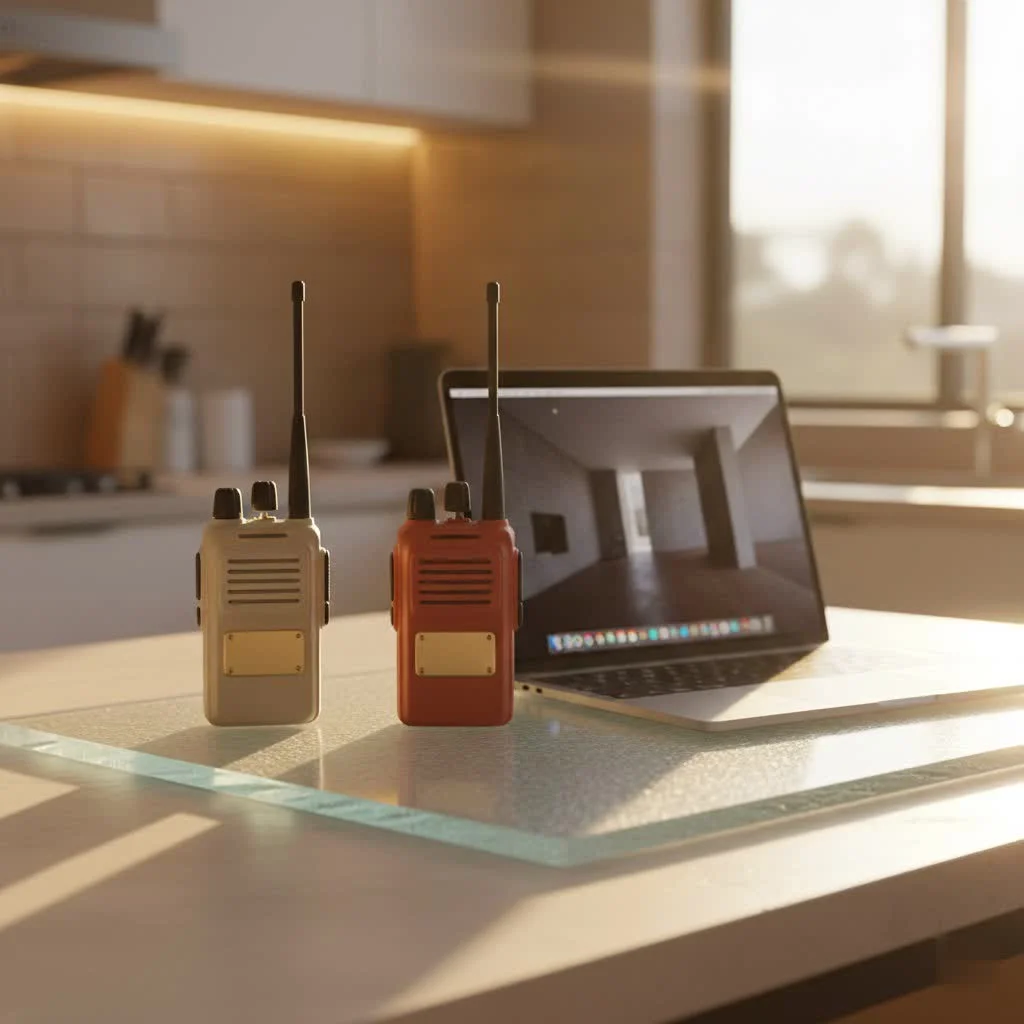
The “50-Mile” Myth vs. Reality: Understanding Ideal Conditions
The advertised “50-mile range” for walkie talkies almost always refers to communication under “ideal conditions.” This means two devices with a perfect, unobstructed line of sight, such as from one mountaintop to another, with no trees, buildings, or hills in between. These conditions are rarely encountered in everyday use. For browse all reviews articles on this site.
In practical, real-world situations, especially with consumer-grade handheld walkie talkies, typical ranges are much more modest. In dense urban environments, effective range might be 0.5 to 1 mile. In heavily wooded areas or rolling hills, you could expect 2 to 5 miles. Open, flat terrain might extend that to 5-8 miles. Achieving 50 miles requires not only ideal conditions but often a combination of powerful equipment, specialized setups, and sometimes a license. Manufacturers present the absolute theoretical maximum, which serves as a benchmark rather than a guaranteed performance for typical use.
Key Factors That Shape Your Walkie Talkie’s Reach
Several critical factors influence a walkie talkie’s performance and effective range. These elements interact to determine how far your two-way radio signal can travel.
Line of Sight: The Unbreakable Rule of Radio Waves
Radio waves, particularly the UHF and VHF frequencies used by most walkie talkies, travel in a relatively straight line. This makes “line of sight” the most important factor for long-range communication.
The Earth’s curvature naturally limits direct line of sight over long distances. Physical obstructions like mountains, hills, dense forests, and man-made structures (buildings, bridges) further impede signals. Each obstacle can absorb, reflect, or completely block radio waves, significantly reducing communication distance. For significant range, a clear, unobstructed path between devices is essential.
Frequency Bands: UHF vs. VHF – Choosing Your Battlefield
Walkie talkies operate on different frequency bands, primarily Very High Frequency (VHF) and Ultra High Frequency (UHF). Selecting the correct band for your environment is crucial:
- VHF (136-174 MHz): These signals have longer wavelengths and are ideal for open, flat areas with minimal obstructions, such as over water, across fields, or in rural regions. They travel farther in these environments because their longer waves can bend slightly over gentle terrain and are less affected by minor topographical changes. However, VHF struggles to penetrate solid objects like buildings or dense foliage.
- UHF (400-475 MHz): UHF signals have shorter wavelengths, making them more effective at penetrating steel, concrete, and other materials common in urban environments. This allows them to perform better within buildings or in areas with moderate obstructions, as they can “bounce” around obstacles. The trade-off is that in truly open areas, their overall range might be slightly less than VHF, and they are more quickly attenuated by dense materials.
Knowing your typical operating environment helps you select the optimal frequency band for your walkie talkie.
Power Output (Wattage): More Isn’t Always More (Legally Speaking)
|
Our Picks for the Best Walkie Talkies in 2026
As an Amazon Associate I earn from qualifying purchases.
|
||
| Num | Product | Action |
|---|---|---|
| 1 | pxton Walkie Talkies Rechargeable Long Range Two-Way Radios with Earpieces,2-Way Radios UHF Handheld Transceiver Walky Talky with Flashlight Li-ion Battery and Charger(2 Pack) |

|
| 2 | Retevis RT22 Walkie Talkies Rechargeable Hands Free 2 Way Radios Two-Way Radio(6 Pack) with 6 Way Multi Gang Charger |
|
| 3 | AILOCITAG Kids Video Walkie Talkies, 2 Pack Rechargeable HD Video Walkie Talkie, No WiFi Needed, 1640 ft Outdoor Range, Secure 1-to-1 Channel, 4 Voice Effects for Boys Girls Ages 3–12 |
|
| 4 | LỖI |
|
| 5 | Retevis RB48 Waterproof Walkie Talkies, Heavy Duty Two Way Radio, Advanced Triple Proof, Vibration Call, USB-C, SOS,2000mAh, NOAA, 2 Way Radio(2 Pack) Yellow |
|
| 6 | Wishouse Walkie Talkies Rechargeable for Kids Adults Long Range,Xmas Birthday Gift for Boys Girls 3 4 5 6 7 8 9 10 Year Old,Hiking Camping Gear Games Ideas Toys with Flashlight,VOX,Easy to Use 4 Pack |
|
| 7 | Retevis RT22 Two Way Radio Long Range Rechargeable,Portable 2 Way Radio, USB-C Charging, Handsfree Walkie Talkies for Adults Cruise Hiking Camping(4 Pack) |
|
| 8 | Retevis RB48 Heavy Duty Waterproof Walkie Talkies, Long Range Rechargeable Two Way Radios, Advanced Triple Proof, Vibration Reminder, for Warehousing Construction Contractor(10 Pack) |
|
| 9 | Retevis RT68 Walkie Talkies with Earpiece, Portable FRS Two-Way Radios Rechargeable, with 6 Way Multi Unit Charger, Hands Free, Long Range, Rugged 2 Way Radios 6 Pack for Adults School Church |
|
| 10 | Walkie Talkies, MOICO Long Range Walkie Talkies for Adults with 22 FRS Channels, Family Walkie Talkie with LED Flashlight VOX LCD Display for Hiking Camping Trip (Orange 2 Pack) |
|
The power output, measured in watts (W), directly affects how far a walkie talkie’s signal can travel. Higher wattage generally means a stronger signal and potentially greater range. However, regulations govern power levels:
- FRS (Family Radio Service) Radios: These are license-free and typically have a maximum power output of 0.5 to 2 watts for handheld devices. Their range is inherently limited by this lower power.
- GMRS (General Mobile Radio Service) Radios: GMRS radios can operate at higher power levels, with handheld units reaching up to 5 watts and mobile/base stations capable of 50 watts. This significant increase in power allows for much greater range and clarity, especially when combined with external antennas or repeaters. Operating GMRS radios requires an FCC license in the United States, which is relatively easy to obtain and covers an entire family.
Antenna Quality and Placement: Your Signal’s Best Friend
The antenna acts as the voice and ears of your walkie talkie. A high-quality, properly tuned antenna is essential for efficient signal transmission and reception. Antenna length and design are crucial, as they are optimized for specific frequencies.
Most handheld walkie talkies use a relatively short, helical antenna, which is a compromise for portability. For specialized long-range setups, larger, external antennas mounted high up can maximize line of sight and signal gain. These are typically used with GMRS or amateur (ham) radio systems and are less practical for casual handheld use.
Environmental Obstacles: From Cityscapes to Wilderness
The physical environment dramatically impacts a walkie talkie’s range:
- Urban Environments: High-rise buildings, metal structures, and dense infrastructure cause signal reflection, absorption, and blocking. This can reduce a theoretical 50-mile range to less than a mile.
- Dense Forests: Thick foliage can absorb and scatter radio waves, reducing range.
- Hilly or Mountainous Terrain: These are significant signal blockers. Even a small hill can completely block communication between two radios on opposite sides.
- Weather Conditions: Rain, heavy fog, and high humidity can slightly attenuate (weaken) radio signals, leading to reduced clarity and range over long distances.
Interference and Signal Clarity: The Unseen Saboteurs
Beyond physical barriers, electromagnetic interference can disrupt radio signals. Devices like cell phones, Wi-Fi networks, power lines, and other radios on nearby frequencies can cause static, choppy audio, or complete signal loss, thereby shortening effective range.
Maximizing Your Walkie Talkie’s Effective Range: Expert Tips
Even without a 50-mile behemoth, you can significantly boost your walkie talkie’s performance by following these expert tips:
- Seek Higher Ground: This is the golden rule. The higher your position, the better your line of sight, and the further your signal can travel. Even a small elevation can make a significant difference.
- Maintain Clear Line of Sight: Before transmitting, try to position yourself so there are no large obstructions (buildings, mountains, dense tree lines) directly between you and the person you’re trying to reach.
- Understand Your Frequency: If your walkie talkie allows for dual-band operation or channel selection, experiment. Use VHF for open areas and UHF for obstructed environments.
- Ensure Fully Charged Batteries: A weak battery reduces power output, directly impacting range and signal clarity. Always start with a full charge.
- Consider GMRS and Repeaters (with a License): For serious long-range needs, a GMRS radio operating with a repeater system can dramatically extend communication range, often far beyond a direct handheld connection. Repeaters receive a signal and re-transmit it with greater power from a higher elevation, acting as a crucial bridge.
- Upgrade Antennas (Where Permissible): For many GMRS and amateur radio devices, aftermarket high-gain antennas can be used. These are designed to focus your signal more effectively, improving range. Always ensure modifications are legal and compatible.
- Strategic Placement: When using a base station or mobile unit, carefully consider antenna placement. Mounting an external antenna as high and clear as possible will yield the best results.
As Maria Sanchez, a lead communications specialist, often says, “The best walkie talkie isn’t always the one with the biggest number on the box; it’s the one you understand and use smartly within its environment.”
Beyond Traditional Walkie Talkies: When 50 Miles Isn’t Enough
Sometimes, even with optimized GMRS radios, a true 50-mile range in challenging terrain might be unrealistic for a handheld device. When “unlimited” range is genuinely needed, consider technologies beyond traditional walkie talkies:
- Satellite Messengers: These devices offer global communication by sending messages via satellite. While not instant two-way voice communication, they provide vital contact in remote areas without cellular service and typically require a subscription.
- LTE Push-to-Talk (PoC) Radios: These devices use cellular networks (like 4G/5G) for communication, providing “unlimited” range wherever cell service is available. They combine instant walkie talkie communication with vast cellular network coverage, often requiring a SIM card and service plan.
Conclusion
The pursuit of a “50-mile walkie talkie” often begins with an exciting promise but leads to a deeper understanding of radio physics and real-world limitations. Achieving such an impressive communication distance with a walkie talkie is complex, heavily reliant on environmental factors, power output, antenna quality, and often, licensing and specialized equipment like repeaters. For most casual users, true 50-mile communication with a handheld device is more of a theoretical maximum than a practical reality.
However, with the right knowledge—understanding line of sight, choosing appropriate frequencies, maximizing power where permissible, and leveraging environmental advantages—you can significantly extend your walkie talkie’s effective range. Whether coordinating a wilderness expedition or managing a team at an event, mastering these principles empowers you to make confident, reliable communication choices. Don’t let advertised numbers dictate your expectations; instead, let expertise guide your way to truly effective long-range communication.
Maximize Your Walkie Talkie's Effective Range
Learn how to significantly boost your walkie talkie's performance and extend its communication distance in various environments.
Always try to position yourself on the highest available ground. Increased elevation improves line of sight, allowing your signal to travel further with fewer obstructions. Even a small hill can make a noticeable difference in range.
Before transmitting, ensure there are no large physical obstructions like buildings, mountains, or dense tree lines directly between you and the person you are trying to reach. A clear path is crucial for radio wave propagation.
If your walkie talkie supports dual-band operation or channel selection, choose the appropriate frequency. Use VHF for open areas like fields or water, and UHF for obstructed environments such as urban areas or dense forests, as UHF penetrates obstacles better.
Always start with fully charged batteries. A weak battery can lead to reduced power output, which directly impacts your walkie talkie's signal strength, clarity, and overall range. Consistent power is essential for optimal performance.
For serious long-range needs, utilize GMRS radios, which offer higher power, and connect to repeater systems. Repeaters receive your signal and re-transmit it with greater power from a higher elevation, dramatically extending your communication range beyond direct handheld capabilities. An FCC license is required for GMRS operation.
Get our weekly buyer guide
Practical specs, not advice. Unsubscribe anytime.

I picked up a set of those cheap Baofengs mentioned, hoping for better range than my old ones. While they’re okay for short distances around the campsite, I was a bit disappointed when trying to communicate across a lake. The 1-8 mile real-world range estimate is definitely accurate, but I was hoping for something closer to the higher end. They’re good for the price, but don’t expect miracles in dense areas.
I got a pair of Midland X-Talker walkie talkies for our family camping trips, and they’ve been fantastic. The point about optimizing your setup really resonated, and we’ve found that getting to a slightly higher elevation makes a noticeable difference. They’re easy to use, and the sound quality is clear. Great for keeping track of the kids when they’re exploring a bit further out.
This post was super helpful in setting my expectations. I used to think those advertised ranges were what I’d actually get. I ended up investing in a higher-power GMRS radio for our off-roading adventures, and it’s made a huge difference. We’re consistently getting 5-6 miles even with some obstructions, which is exactly what we needed to stay in touch across our convoy. No more dropped signals!
I’ve been using the Motorola T800 for hiking trips, and it’s been pretty solid. The article really hit the nail on the head about the ’50-mile’ thing; I usually get about 3-4 miles in hilly, wooded areas, which is perfectly fine for our group. Battery life is decent, and it’s rugged enough for outdoor use. Definitely recommend for anyone needing reliable comms in moderate terrain.