Ever found yourself in a situation where your cell phone signal just vanishes? Maybe you’re deep in the wilderness, orchestrating a bustling event, or simply trying to keep tabs on your team across a large job site. That’s where Walkie Talkies step in, acting as your dependable lifeline when other communication fails. Here at Oqdos.com, with over 15 years in the field, I’ve seen these robust devices evolve, proving time and again that they’re far more than just toys. They are essential tools for instant, reliable communication, perfectly suited for countless scenarios where staying connected isn’t just a convenience – it’s a necessity.
What Exactly are Walkie Talkies and How Do They Work?
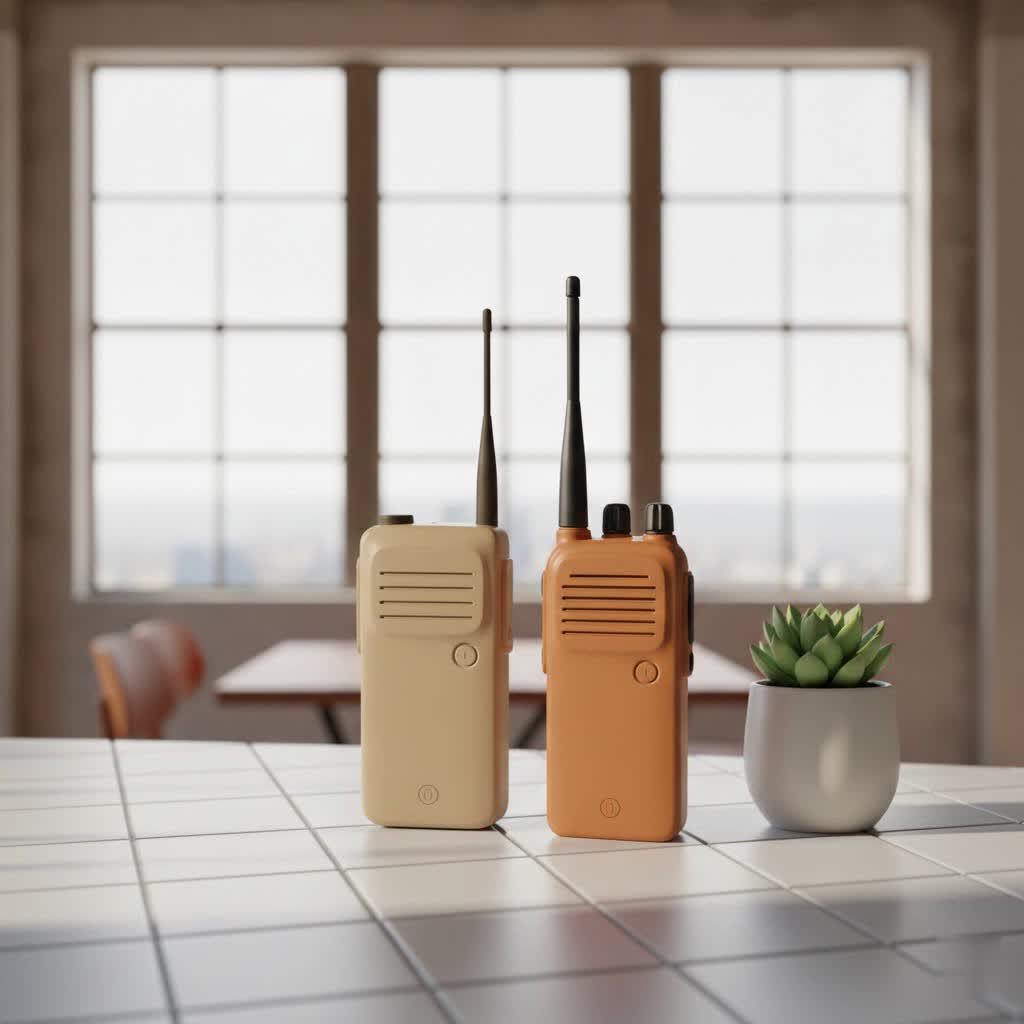
At its core, a walkie talkie is a handheld, portable two-way radio transceiver. Think of it as a personal broadcasting station you can hold in your hand. Unlike your cell phone, which relies on complex cellular networks and towers, walkie talkies communicate directly with each other using radio waves. This direct line of communication is often referred to as “half-duplex,” meaning that while multiple units can listen, only one person can transmit at any given time.
The magic happens when you press that “Push-To-Talk” (PTT) button. Your voice is instantly converted into electrical signals, which are then transformed into radio waves and broadcast through the antenna on a specific frequency or channel. These radio waves travel at the speed of light, reaching other walkie talkies tuned to the same channel almost instantaneously. When you release the PTT button, your device switches back to receiver mode, ready to pick up incoming messages. It’s a beautifully simple yet incredibly effective system, allowing for quick, group-wide communication without the need for dialing, waiting, or worrying about network congestion.
A Deep Dive into Walkie Talkie Types: Finding Your Perfect Match
Choosing a walkie talkie isn’t a one-size-fits-all scenario. The right device for you largely depends on your specific needs, the environment you’ll be using it in, and the range you require. Let’s break down the main categories.
License-Free & Ready to Go: FRS & MURS Radios
For many casual users, recreational activities, or light professional duties, license-free walkie talkies are the perfect entry point.
- FRS (Family Radio Service): These are perhaps the most common walkie talkies you’ll encounter on store shelves. FRS radios are designed for short-range communication and are completely license-free for personal use in the U.S. and Canada. They typically operate at 0.5 to 2 watts of power, making them ideal for families at a theme park, friends hiking on a trail, or keeping in touch around the campsite. They’re straightforward, easy to use, and a great choice for general recreational purposes.
- MURS (Multi-Use Radio Service): A step up from basic FRS, MURS radios also don’t require a license. They operate on five specific VHF frequencies and generally have a power output of up to 2 watts. What sets MURS apart is the ability to program private channels, which can be a real boon for small businesses or groups looking for a bit more privacy. They offer a good balance of power and simplicity for various light-duty professional or enhanced recreational applications.
|
Our Picks for the Best Walkie Talkies in 2026
As an Amazon Associate I earn from qualifying purchases.
|
||
| Num | Product | Action |
|---|---|---|
| 1 | pxton Walkie Talkies Rechargeable Long Range Two-Way Radios with Earpieces,2-Way Radios UHF Handheld Transceiver Walky Talky with Flashlight Li-ion Battery and Charger(2 Pack) |

|
| 2 | Retevis RB48 Waterproof Walkie Talkies, Heavy Duty Two Way Radio, Advanced Triple Proof, Vibration Call, USB-C, SOS,2000mAh, NOAA, 2 Way Radio(2 Pack) Yellow |
|
| 3 | Retevis RT22 Walkie Talkies Rechargeable Hands Free 2 Way Radios Two-Way Radio(6 Pack) with 6 Way Multi Gang Charger |
|
| 4 | Walkie Talkies, MOICO Long Range Walkie Talkies for Adults with 22 FRS Channels, Family Walkie Talkie with LED Flashlight VOX LCD Display for Hiking Camping Trip (Orange 2 Pack) |
|
| 5 | Retevis RT68 Walkie Talkies with Earpiece, Portable FRS Two-Way Radios Rechargeable, with 6 Way Multi Unit Charger, Hands Free, Long Range, Rugged 2 Way Radios 6 Pack for Adults School Church |
|
| 6 | Wishouse Walkie Talkies Rechargeable for Kids Adults Long Range,Xmas Birthday Gift for Boys Girls 3 4 5 6 7 8 9 10 Year Old,Hiking Camping Gear Games Ideas Toys with Flashlight,VOX,Easy to Use 4 Pack |
|
| 7 | LỖI |
|
| 8 | Retevis RT22 Two Way Radio Long Range Rechargeable,Portable 2 Way Radio, USB-C Charging, Handsfree Walkie Talkies for Adults Cruise Hiking Camping(4 Pack) |
|
| 9 | AILOCITAG Kids Video Walkie Talkies, 2 Pack Rechargeable HD Video Walkie Talkie, No WiFi Needed, 1640 ft Outdoor Range, Secure 1-to-1 Channel, 4 Voice Effects for Boys Girls Ages 3–12 |
|
| 10 | Retevis RB48 Heavy Duty Waterproof Walkie Talkies, Long Range Rechargeable Two Way Radios, Advanced Triple Proof, Vibration Reminder, for Warehousing Construction Contractor(10 Pack) |
|
Stepping Up Your Game: GMRS & Licensed Professional Radios
When you need more power, greater range, or robust features for demanding environments, you’ll likely be looking at licensed options.
- GMRS (General Mobile Radio Service): If you’re serious about range and reliability for outdoor adventures, large property management, or coordinated group activities, GMRS radios are often the answer. While they share some frequencies with FRS, GMRS devices can transmit at up to 5 watts, significantly boosting their range and signal penetration. The catch? You’ll need a license from the FCC to operate them. Good news, though: one GMRS license covers an entire family, making it a valuable investment for avid outdoor enthusiasts or large family groups.
- Professional Radios: Designed for industries like construction, security, event management, and emergency services, professional walkie talkies are built for endurance and critical communication. They often boast higher power outputs, superior durability, advanced encryption options, and can be custom-programmed to specific frequencies. These typically require business-specific licensing or fall under specialized service allocations, ensuring clear and dedicated communication channels for critical operations.
Exploring Other Specialized Options
The world of two-way radios also includes highly specialized types:
- Amateur (Ham) Radios: For the dedicated hobbyist, amateur radios offer a vast array of frequencies and advanced features. Operating these requires passing a certification test, opening up a world of long-distance communication and technical exploration.
- PoC Radios (Push-to-Talk over Cellular): These modern devices leverage existing cellular or Wi-Fi networks instead of traditional radio frequencies. Essentially, they act like walkie talkies but with potentially nationwide coverage, as long as there’s a cellular signal. While offering extensive range, they do rely on infrastructure that traditional walkie talkies are designed to bypass.
Understanding Walkie Talkie Frequencies: UHF vs. VHF
The frequency band your walkie talkie operates on is a crucial factor, dictating its performance in different environments. We primarily talk about two main categories: Very High Frequency (VHF) and Ultra High Frequency (UHF).
- VHF (Very High Frequency – 30-300 MHz): VHF signals are like long, smooth waves on an open ocean. They travel farther in open, unobstructed areas like flat fields, across water, or in sparsely wooded terrain. If your primary use is across large open spaces with clear line of sight, VHF might offer better range for the same power output. However, these longer waves struggle to penetrate obstacles. Buildings, dense foliage, or hilly terrain can easily block or significantly reduce their signal.
- UHF (Ultra High Frequency – 300-3000 MHz): UHF signals, on the other hand, are shorter and choppier, like ripples in a pond. This characteristic allows them to “bounce” and “bend” around and through obstacles more effectively. If you’re operating in urban environments, inside buildings, or in heavily wooded areas, UHF radios are generally the superior choice. Most consumer-grade walkie talkies sold today operate on UHF frequencies because they perform better in a wider variety of real-world, obstructed conditions.
It’s vital to remember that VHF radios cannot communicate with UHF radios. They speak entirely different “languages” of radio waves. So, if you’re coordinating with a group, ensure everyone is on the same frequency band. Beyond the band, walkie talkies use specific channels within these frequencies to prevent interference. Many also incorporate privacy codes (like CTCSS or DCS) which filter out unwanted conversations from other users on the same channel, allowing your group to communicate more privately.
Choosing Your Ideal Walkie Talkie: Key Considerations
Selecting the perfect walkie talkie involves balancing your needs with the device’s capabilities. Here’s what my 15 years in the field have taught me to prioritize:
Range and Power: How Far Can You Really Talk?
This is often the first question people ask, and it’s also the most misunderstood. The “30-mile range” advertised on a box is typically a theoretical maximum in perfectly flat, open, obstruction-free conditions (like line-of-sight from mountaintop to mountaintop). In reality, factors like terrain, buildings, dense trees, and even weather can drastically reduce this.
- Power Output (Watts): Higher wattage generally means better range and penetration. FRS radios are typically 0.5-2 watts, while GMRS radios can go up to 5 watts. More power means your signal has a stronger push, but remember, more power usually means more battery drain and potential licensing requirements.
- Environment is King: For typical use in urban areas, a few blocks to a mile might be realistic. In moderately open terrain, 2-5 miles is a good expectation. Always consider where you’ll be using your walkie talkie most often.
Battery Life & Durability: Built for the Long Haul
Imagine being in the middle of a critical operation or a backcountry adventure and your communication device dies. Not ideal!
- Battery Life: Look for models with long-lasting batteries. Lithium-ion batteries often provide the best performance, offering 12-48 hours of use depending on the model and usage patterns. Rechargeable options are usually more economical in the long run.
- Durability and Weatherproofing: For outdoor or demanding job sites, ruggedness is non-negotiable. Look for IP ratings (Ingress Protection). An IP55 rating, for example, means it’s protected against dust and low-pressure water jets, while an IP67 rating indicates it’s fully dust-tight and submersible in water up to 1 meter for 30 minutes. A solid, impact-resistant casing is also crucial.
Features That Matter: Beyond Just Talking
Modern walkie talkies offer a host of features that can enhance usability and safety.
- VOX (Voice-Operated Exchange): This allows for hands-free communication, activating transmission when you speak. Great for tasks where your hands are occupied.
- NOAA Weather Alerts: Essential for outdoor enthusiasts, providing real-time weather warnings.
- GPS Integration: Some advanced models can share your location with other units, a critical safety feature for teams in spread-out environments.
- Emergency Alerts: Dedicated buttons to send distress signals.
- Scan Function: Helps you quickly find active channels.
- Keypad Lock: Prevents accidental setting changes.
- Ease of Use: Don’t underestimate simple, glove-friendly controls, especially if you’ll be using them in harsh conditions.
Licensing: Knowing the Rules
Understanding licensing requirements is crucial to avoid fines and ensure legal operation.
- License-Free: FRS and MURS radios are generally license-free for personal use.
- Licensed: GMRS radios require an FCC license. Amateur (Ham) radios require a certification test. Professional and business radios often have specific licensing needs depending on their power and frequency usage. Always check the regulations specific to your region.
Compatibility: Can My Walkie Talkie Talk to Yours?
A common question! Yes, different brands of walkie talkies can often communicate, but only if they meet a few key criteria:
- Same Frequency Band: Both radios must operate on either VHF or UHF.
- Exact Same Frequency/Channel: They must be tuned to precisely the same frequency.
- Same Privacy Codes: If privacy codes (CTCSS/DCS) are enabled on one, they must be set identically on the other, or both set to ‘no code’.
- Analog vs. Digital: Analog and digital radios generally cannot communicate as they use fundamentally different methods to transmit signals.
Pro Tips from the Oqdos Expert
“In my experience, the biggest mistake people make is overlooking the ‘real-world’ environment. Those advertised ranges are rarely what you’ll get. Always consider the terrain, obstructions, and whether you truly need a license for your intended use. A well-chosen, reliable walkie talkie is an indispensable tool, but a poorly chosen one is just dead weight.” – Elias Vance, Lead Content Creator at Oqdos.com
Frequently Asked Questions (FAQ)
How far can a walkie talkie reach?
The actual range of a walkie talkie varies significantly, typically from less than a mile in urban or heavily obstructed areas to 5-7 miles in open terrain. Theoretical maximums can be much higher but are rarely achievable in real-world conditions.
Do I need a license for a walkie talkie?
It depends on the type. FRS (Family Radio Service) and MURS (Multi-Use Radio Service) radios are license-free for personal use. GMRS (General Mobile Radio Service) radios require an FCC license, which covers an entire family. Professional and amateur radios also have specific licensing requirements.
Can different brands of walkie talkies talk to each other?
Yes, different brands can communicate if they operate on the same frequency band (UHF or VHF), are tuned to the exact same channel and frequency, and use matching privacy codes (CTCSS/DCS). However, analog and digital radios are generally not compatible.
What’s the difference between UHF and VHF walkie talkies?
UHF (Ultra High Frequency) radios excel in areas with obstructions like buildings, hills, or dense foliage because their shorter waves can penetrate or navigate around obstacles more effectively. VHF (Very High Frequency) radios perform better in open, outdoor areas with clear lines of sight, as their longer waves travel farther without obstruction.
Are walkie talkies good for emergencies?
Absolutely. Walkie talkies are excellent for emergency situations because they don’t rely on cellular networks, which can become overloaded or fail during disasters or power outages. They provide instant, direct communication, making them invaluable for coordination and safety in remote areas or during crises.
What does the “range” on a walkie talkie box actually mean?
The advertised “range” on a walkie talkie box typically refers to the maximum theoretical range achievable under ideal, unobstructed line-of-sight conditions. This is usually not indicative of the actual performance you’ll experience in real-world environments with typical terrain, buildings, or other interference.
Conclusion
Walkie talkies, or two-way radios, remain an incredibly valuable and often superior communication tool in a world dominated by smartphones. Their instant, reliable, and network-independent communication capabilities make them indispensable for everyone from outdoor adventurers and event organizers to emergency responders and industrial teams. By understanding the different types, frequencies, and key features, you can confidently choose the perfect walkie talkie to keep you connected, no matter where your journey takes you. So, explore the possibilities, weigh your options, and get ready to experience the power of direct, clear communication. We at Oqdos.com are always here to help you make the most of your two-way radio experience!
